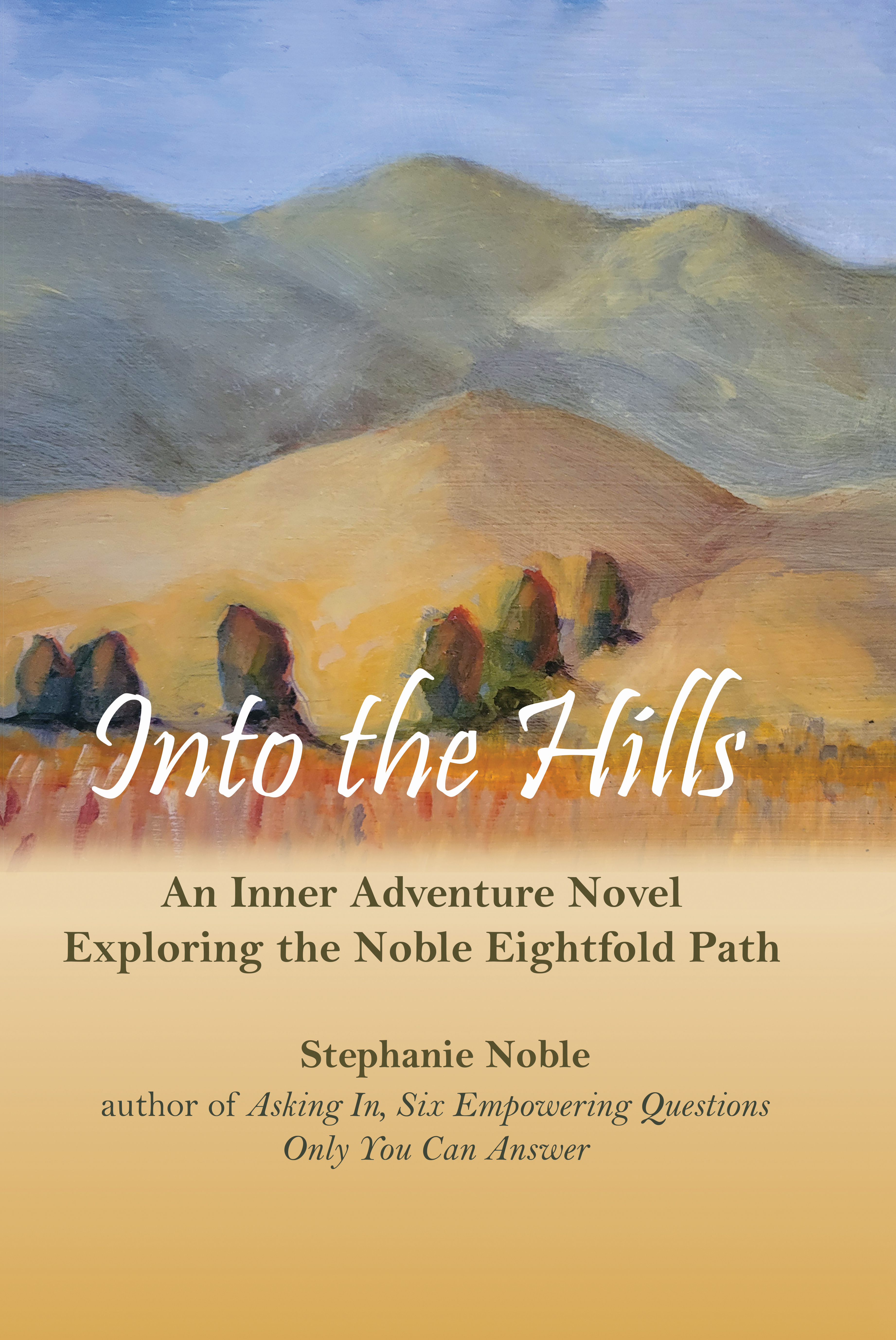
Into the Hills
An Inner Adventure Novel
Exploring the Noble Eightfold Path
by Stephanie Noble
Available online:
Spirit Rock Online Bookstore
Amazon
Or ask your favorite
independent bookstore
350 pages
6 x 9″ paperback
$18.00 USD
ISBN# 978-0-9638088-4-4
(Kindle edition available on Amazon)
If you read it and loved it, recommend it!
Please write a review on Goodreads!
And/or, if you’re an active Amazon Prime member, review it on Amazon. It doesn’t have to be lengthy. The five stars reset the algorithm, making it more visible to others.
Suggest it to friends, and consider it for your book group.
Reread it yourself, using the accompanying workbook for inner investigation. Let Stephanie know if you would like to join a Zoom 8FP exploration using the downloadable workbook.
Haven’t read it yet? Read these reviews:
“A gusto-filled journey through the heart of Buddhist wisdom – a great refuge and guide for anyone from any background. The page-turning plot keeps you moving along, with heart-centered helpfulness sinking in along the way. A pleasure to read, with echoes that linger.”
~ Rick Hanson, Ph.D., New York Times Bestselling author of Buddha’s Brain, Hardwiring Happiness, and Resilient
“Stephanie brings a fresh and deeply creative approach to the Dharma, weaving the teachings of the Eightfold Path through the arc of a compelling story. In doing so, she makes the path come alive in a way that is intimate, accessible, and profoundly human. This is a wise and imaginative offering that both engages the heart and illuminates the path of practice.”
~ Mark Coleman, author of Awake in the Wild, Make Peace with Your Mind, and A Field Guide to Nature Meditation; co-founder of the Mindfulness Training Institute.“Framing these timeless teachings within a story of personal challenges feels fresh and engaging. As we follow the characters and their life paths, our interest naturally deepens in the teachings themselves. I also appreciated how the retreat unfolds as its own story, shaped by each participant’s perspective. Presented as a lived experience, the wisdom of the dharma feels accessible and alive.” ~ Susan Weir, Founder Insight Ann Arbor
Book Review in Marin Sangha Newsletter (excerpt)
One of Marin Sangha’s guest teachers, Stephanie Noble, has written a combination novel and practice guide that can operate as an excellent way to absorb and assimilate the Buddha’s teachings, especially for those of us who dislike memorizing lists. The author uses a mixture of fiction, metaphor, and examples to illuminate the Eightfold Path and demonstrate how its steps, along with other core Buddhist teachings, work together to help
all people heal afflictive emotions and lead a better life.
Into the Hills is the story of Eva, whose grief for her recently deceased mother is made worse by the prospect of surgery that will prevent her from ever having children of her own. To escape her psychic pain, she takes up with a TV-star handsome, sandalwood-scented hunk completely uninterested in her as a person—he shuts her up with remarks such as
“it’s hard to plant a kiss when you’re mouth’s a moving target.” When he proves dangerous as well as boorish, she flees into the semi-wilderness just outside of town, where she comes upon a mysterious yet friendly multi-ethnic group of people, who invite her to join a private meditation retreat. The bulk of the novel is devoted to this retreat, where its participants discuss the Eightfold Path and other core Buddhist teachings, all very relevant to Eva, who is encountering them for the first time. The use of personal anecdotes and gently presented insights does a good job showing how the teachings can solve real problems in real life. The author also includes metaphors and mnemonics that can help readers keep these teachings in mind, and she introduces various hacks and other skills—
such as envisioning oneself more as a verb than a noun—that employ the Buddha’s wisdom to reduce suffering. Finally, to pull readers further in, the retreat itself presents a mystery: Among other things, readers will eventually find out where, in a campsite miles from the nearest road, those state-of-the-art porta-potties came from!
As an added benefit, the author includes a free, downloadable pdf workbook, which goes deeper into key concepts, including her popular Cooking Pot Analogy for the Eightfold Path.
Best of all, it offers opportunities for readers to understand and apply these concepts to their own experience. Enjoy! -Barbara McHugh, PhD__________________________
Buddhistfiction Blogger, August 21, 2026
Review of Stephanie Noble’s Teaching Novel: INTO THE HILLS
Stephanie Noble wrote to me this summer about her new novel, Into the Hills: An Inner Adventure Novel on the Buddha’s Noble Eightfold Path (Both/And Books, 2026), along with a review copy and a brief press release. From the press release I learned that Noble is “a member of the Board of the Buddhist Insight Network, [who] actively connects with meditation teachers and sangha leaders in the modern Insight community.” She has been sharing her understanding of the Buddha’s teachings with students, blog followers, and readers for more than two decades, and “she has a large following on Insight Timer.” It was the mention of the popular meditation app that told me where I had seen her name before. Her guided meditations on anxiety, upset, and sleep practice are some of my favourites.
I finally got to sit down with Noble’s book this past month, and I was curious about what she calls a novel that teaches. Usually I approach works of Buddhist fiction with an eye for the Buddhist narrative threads running through them. I look for the threads I can tie back to canonical and non-canonical Buddhist stories, and to practices across all types of Buddhism, in order to answer the question “what is Buddhist about this novel?” But Noble announces the narrative threads she uses in the book’s title. Noble’s Introduction, Acknowledgements, and About the Author section further ground her story of the Eightfold Path in her Insight practice. So the interesting question with this book was not “what is Buddhist about this novel” but “how engaging is a novel of Buddhist fiction when it is written to teach?”
The story itself is direct. Protagonist Eva is a middle-aged schoolteacher grieving her mother and making some poor choices to soften that grief. She flees into the hills above her town with her dog Trusty, falls, and wakes to an invitation to join a small meditation nature retreat. Over the days that follow, each member of the group presents one aspect of the Eightfold Path. Then Eva wakes a second time, in a hospital bed, and we learn that the retreat was a dream she had while unconscious.
Noble is candid about her method. In the introduction she acknowledges that a novel which teaches is an unusual thing, and that some readers will find her approach “unorthodox and even unacceptable”. I appreciate the honesty, and I think the frame she chose is the shrewdest decision in the book. By making the retreat a dream, Noble follows in the tradition of Buddhist dream journey narratives and also takes the opportunity to run long stretches of instruction without the story breaking underneath her, because a dream is permitted to be didactic in a way that a waking scene is not. Her title for Part Three, “There’s No Place Like Home,” references The Wizard of Oz and tells us she knows precisely she is working within two traditions of dream journey narratives, one Buddhist and one fictional.
Is the story heavy handed in places? Yes, and knowingly so. The retreatants are built as mnemonics. Vicente teaches Wise View, Minna teaches Wise Mindfulness, Lily teaches Wise Livelihood, and the local politician who troubles the plot is named Gregory Allen Dean, whose initials give us greed, aversion, and delusion. Once a reader notices this pattern it cannot be unnoticed, and the characters do grow a little thinner for carrying it. What holds the book together is Eva herself. Her grief is particular rather than general, her embarrassment is well observed, and she resists the retreat long enough to be believable when she stops resisting. Early in the retreat, Eva arranges her breakfast on the plate carefully enough to call it a still life, and then eats it anyway. That is this book at its best.
When I finished the novel, I wondered who was Noble’s intended audience. Her introduction gestures toward readers who have never heard of the Eightfold Path at all, so Into the Hills could be kindly placed in the hands of newcomers. It could also be useful in the hands of sangha book groups, where the discussion chapters and the free companion workbook could do genuine work together. If you take the opportunity to read Into the Hills, comment below and tell me whether the dream held for you.
- Kimberly Beek, BuddhistFiction Blogger
Posted on August 31, 2026 by Kimberly Beek – Buddhistfiction Blogger | Leave a comment
Letters from Readers:“I finished your wonderful book yesterday. Bravo! I feel so much more connected to the Eightfold Path after reading it. Your passion for this material and for teaching it is clear as a bell and, probably because you have taught it for so long to responding students, you could anticipate the questions and difficulties and address them as you went along. I intend to read it again. It’s both an intriguing story and a clear text. Your generosity abounds!” ~ Laurie Oman, author of Walking Each Other Home Again
“Just finished your new book Into The Hills. What a treat. Thank You!
“At times I felt I was in Eva’s shoes while I attended my first retreat at Spirit Rock. The wonderment of all that was unfolding moment to moment.
“Great job!” ~ Bill Wickliffe
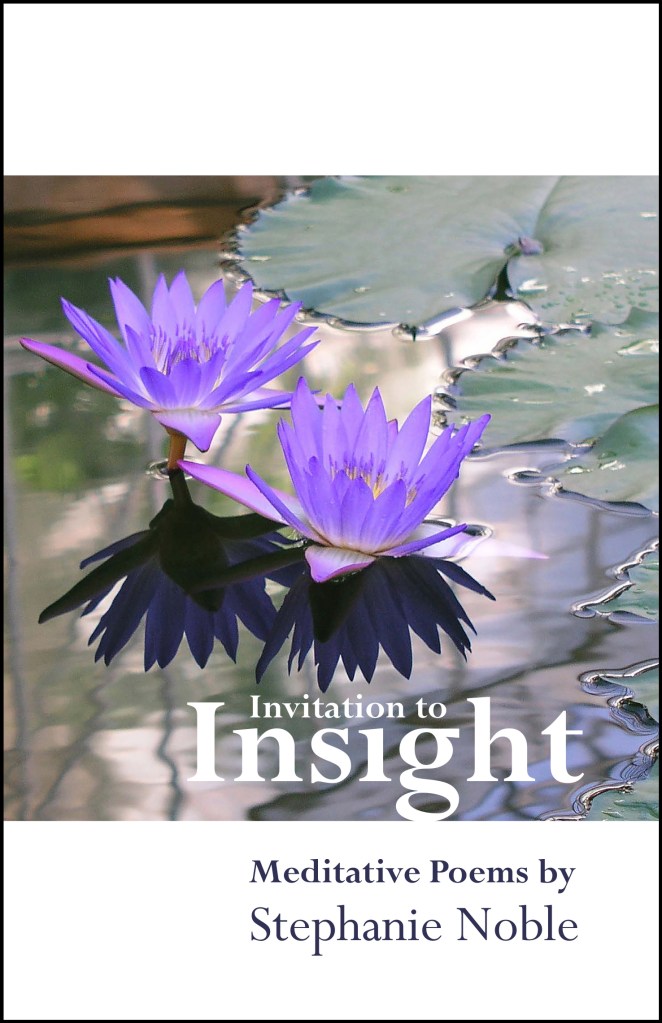
Invitation to Insight
Meditative Poems
by Stephanie Noble
Available online
Spirit Rock Online Bookstore
(Also carried the SRMC store)
Bookshop.org
Amazon
or from your local independent bookseller
90 pages
5 x 7″ paperback
$12.00 USD
From silence, words arise that guide us. No matter the tradition, it has always been so. Poems from spacious stillness resonate with our own wisdom, inspiring us. The poems in this book came from days spent on silent meditation retreats and solitary walks in nature, listening, looking, and letting the words come. They offer an invitation to insight.
“Stephanie Noble’s poems sing, whisper, and wink from the heart of a meditator’s journey. With vivid imagery, candor, and wisdom, Invitation to Insight honors both the quirky humanity and the glimmering mystery of the dharma path.”
~Anne Cushman, author of The Mama Sutra: A Story of Love, Loss, and the Path of Motherhood and Enlightenment for Idiots: A Novel
“Stephanie Noble’s strikingly honest poems focus a steady compassionate light on our ordinary days, with their requisite to-do lists, check-out lines, and imaginary getaway cars. Her poetic meditations reveal the humor, wisdom, and grace that can enter us when we let go and Let Them All Come In.”
~ Prartho Sereno, Marin County poet laureate emerita, author of Starfall in the Temple, Indian Rope Trick, and 3 other poetry collections.
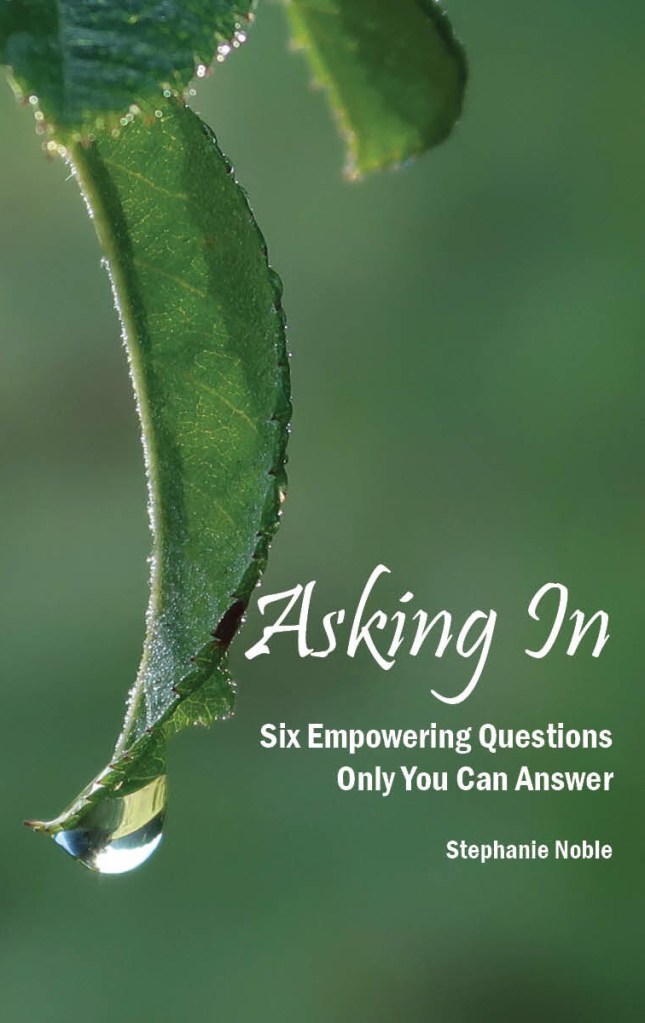
ASKING IN
Six Empower Questions
Only You Can Answer
Available on:
Spirit Rock Online Bookstore
Amazon
or from your local independent bookseller
80 pages
5 x 7″ paperback
$8.00 USD
Six key questions that transform confusion into clarity. This book comes from years of teaching meditation and helping people discover how to live with joy, meaning, and purpose. An excellent workbook on your own or in a group.
“This book is a marvelous invitation into profound inner freedom, contentment, and peace. With simple questions, Stephanie Noble draws on her own depth of practice to guide readers home to the happiness and love that is their true nature. Informed by modern psychology and ancient wisdom, this is a beautiful book.”
~ Rick Hanson, Ph.D., author of Resilient: How to Grow an Unshakable Core of Calm, Strength, and Happiness
Reviews
A simple, profound gift to oneself
“Although a short book, Asking In is not to be read through cover to cover in one sitting. The six questions provide a beautifully crafted guide to help you gain insight into your life’s journey. In its simplicity, you can find clarity, deep wisdom, and an understanding of oneself. It can be used daily to find your truth, ease, peace, and path. Stephanie provides the tools, and it’s up to you to take them where you will. As Stephanie so aptly and succinctly states, this book “is a rewarding, healthy habit of a lifetime”. For me, it has revealed much that’s right in front of me that I don’t often see. It’s like cleaning the windshield to see more clearly and the comfort that brings. As simple and terrific as that.”
Wonderful guide to inner journeying
“This book helped me learn more about myself and understand more clearly which of my values benefit my life and which ones do not. Self-reflection can sometimes be a hollow exercise, but this book brings a richness and depth to the practice of inner journeying that creates new experiences and insights each time I read it. I especially like the note-taking spaces because it demonstrates my growth and changes in a visible way.”
I bought six for my friends who are open to learning
“I really enjoyed the insights Ms. Noble presents in her book. It definitely gave me ways to be more mindful in my pursuit of understanding myself and the world. I ordered five more copies to send to my family and friends because I think it is an important topic.”
A powerful guide for self-exploration!
“Asking In is a powerful, inspiring guide to self-exploration. I particularly appreciate its format that allows space for personal commentary on each question. I expect it is a book I will be reading over and over at different times in my life as the need arises.”
Helpful in stressful times
“Clear, inviting questions to open your heart and mind. Well written and helpful in stressful times and calm times, too.”
An important book
“You can use this inspiring book as a workbook to investigate beneath the surface of everyday situations and feelings. I love how clear and well-organized it is and how each chapter includes episodes from Stephanie’s life elucidating the inquiry she is inviting us to pierce. Can’t afford a therapist? This book is the next best thing. It’s short but dense with helpful ideas and, yes, really essential questions to guide our exploration.”
A succinct exploration guided by wisdom and compassion
“There are certainly thousands of books out there now on some combination of personal suffering, Buddhism, mindfulness, and meditation. So many books, so little time—even in a pandemic, it seems. For me, Stephanie’s “Asking In” fills a unique niche in the genre. First, it’s succinct at 127 pages. She doesn’t beat around the bush with the historical or philosophical trappings of Buddhism. Those can be fascinating, and she clearly knows those fields, but that’s not what this little book is about. It’s not a how-to-meditate guidebook, although there is a chapter at the end about getting started. Instead, this book is a pragmatic and compassionate guide to feeling better in your daily life, in your relationships, and in the social fabric of our world.
“Stephanie Noble’s six questions—refined, she writes, through many years of self-inquiry, meditation practice, and teaching meditation—are aimed at “any situation or quandary we may be in, and they prompt answers that free us to live joyfully with a sense of meaning and purpose.” They’re not one-off questions but are designed to be used again and again as our days bring new challenges (which they will never stop doing as long as we live!). One I know I’ll use a lot is question #2: “What am I afraid of?” Stephanie explores the roots of fear, the collateral damage it causes in our relationships and creativity, and the well-being that arises from investigating and befriending our fears with kindness.
“Asking In is kind of a workbook, actually, as there is space to write down your responses to the questions. I could see her turning this into a bona fide workbook, in a format with even more space to write. Also, a table of contents and index might make those return dives into the questions easier.
“Although Stephanie Noble isn’t a psychologist, for me at least, her insights have offered more ‘Aha!’ moments than those of most of the (many) therapists I’ve spent money on over the years. She has an intuitive grasp of the human heart. In the chapter devoted to the question, “What are my gifts?” Stephanie observes: “When we quiet down our busy lives and give our spacious attention to this moment, we may become aware of a quiet voice of infinite loving-kindness and wisdom. It has no sense of urgency. It never dictates. It simply offers guidance in the form of options.” With these words, Stephanie is actually describing her own compassionate and wise approach in this book.
Read many more five-star reviews on Amazon.
Order books from the Spirit Rock Online Bookstore!
You’ll find Asking In in the Mindfulness section and Invitation to Insight in the Poetry section of the Spirit Rock Online Bookstore.
Or next time you are at Spirit Rock Meditation Center in Woodacre, CA, check out the beautiful bookstore in the Community Hall.
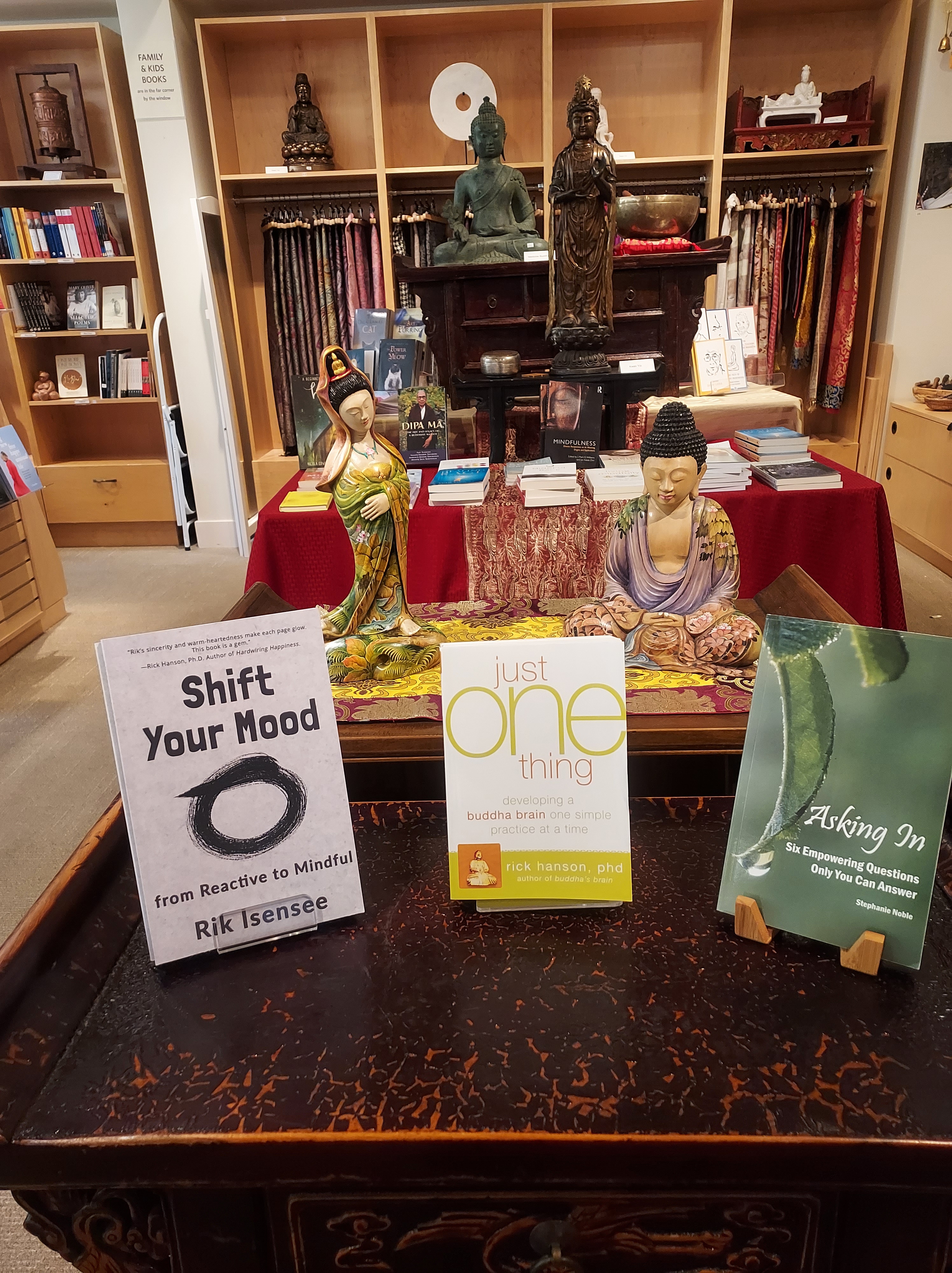
A classic! As fresh and true as ever.
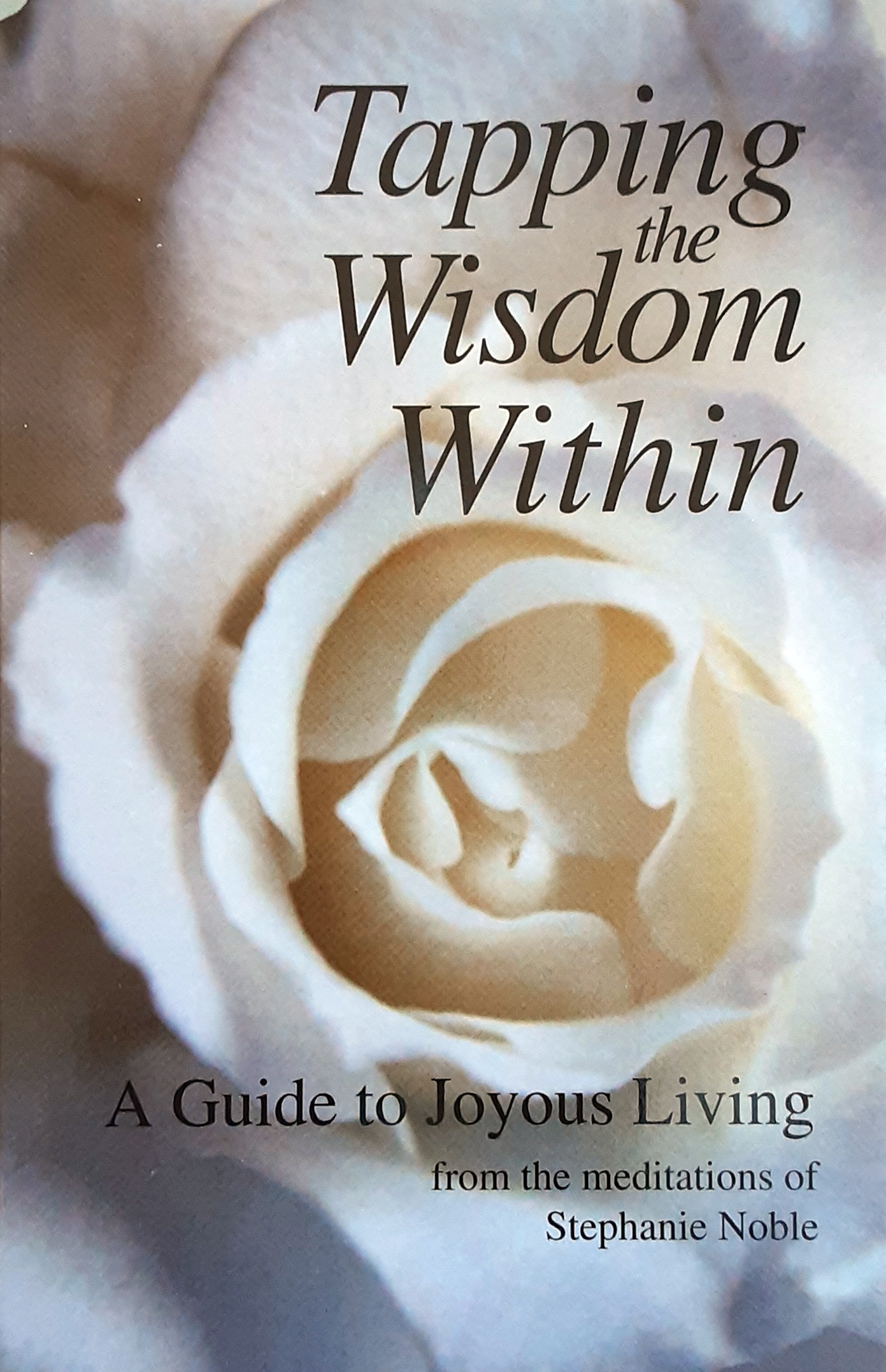
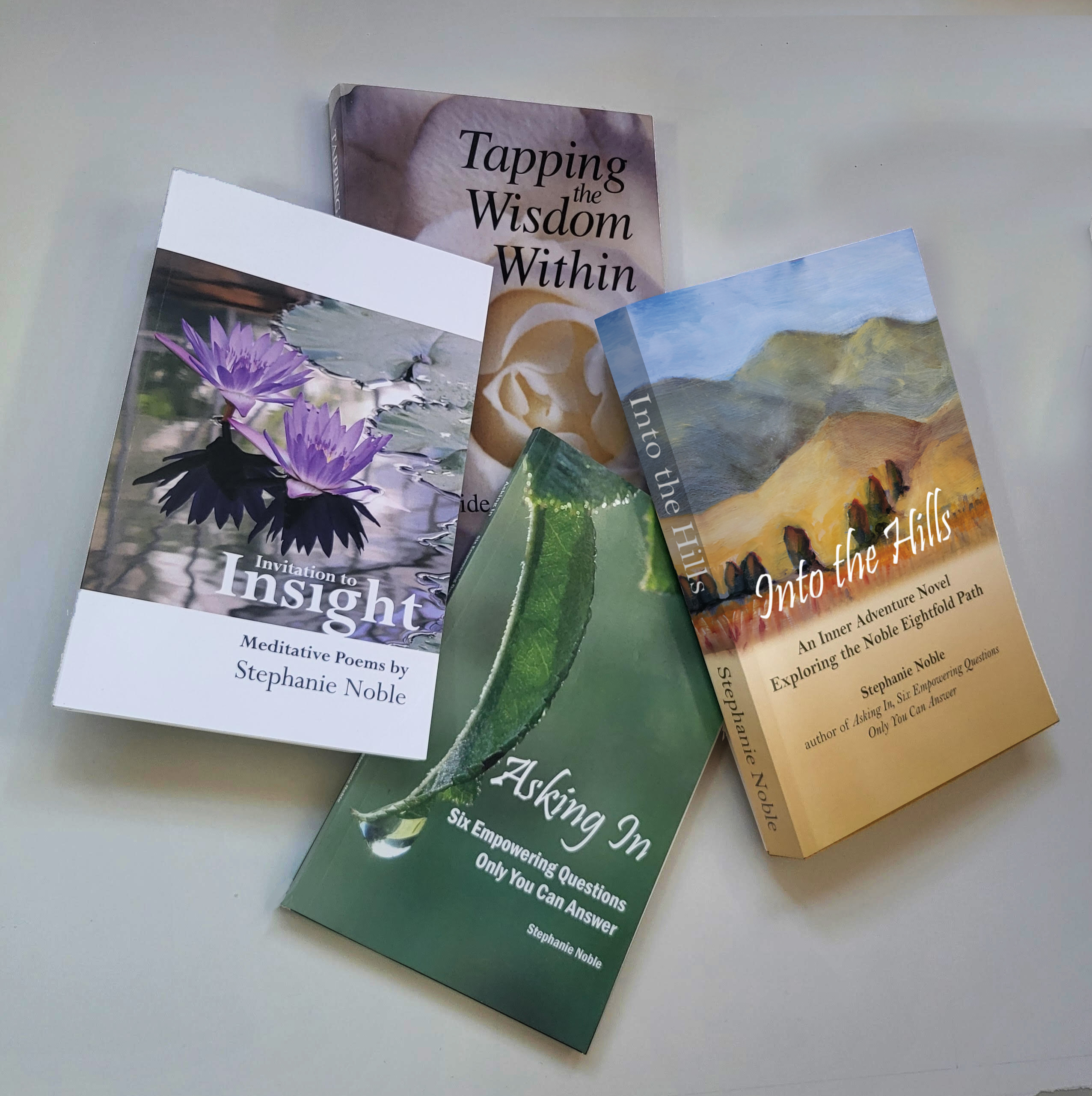
TAPPING THE WISDOM WITHIN,
A Guide to Joyous Living
80 pages
5.5″ x 8.5″ paperback
$10.95 USD
Published in 1994. Contact Stephanie for a copy.
Reviews
REVIEWS
“Each page contains enlightening thoughts and questions that will engage your mind and spirit for many days.” ~ Whole Life Times
“The ideas are presented in a clear and compassionate way, making them easy to understand and embrace…a book to be savored in small, nourishing meals.” ~ The New Times, Seattle
“Stephanie Noble is one of those bright souls who shares her light with the world and makes it a more beautiful place.” ~ Diane Dreher, author of The Tao of Inner Peace
“Tapping the Wisdom Within will be helpful to many people.”
~ Gerald G. Jampolsky, MD, author of Love is Letting Go of Fear
“Tapping the Wisdom Within has given me so much strength, knowledge, understanding, inspiration, and reassurance.” ~ L.M., a daily reader for over twenty years

