

Everything in life is dependent on something else. As much as we might try, we will not find anything that stands separate, alone, and unconditioned. If this arises, then that arises. This fundamental insight of Buddhism is called Dependent Origination. There is a formal teaching and, of course, a list one could memorize. But the Buddha experienced the nature of dependent origination in his meditation and we can too.
But even before we sit to meditate, we can see dependent origination at play: Before meditating there is the intention to meditate. If the intention is wise, the effort will be wise. If the intention is weak or unwise, then the effort will be weak and the result will be more likely to activate suffering rather than ease, peacefulness, and joy.
As an example, when I used to list my Marin Insight Sangha on MeetUp, many signed up for the weekly meeting, but few showed up. Why? For some, the intention was to have the group name on their bio, to be seen as a meditator. Others signed up on impulse but their intention wasn’t strong enough to show up. Others may have had so many things going on their intention got lost in the muddle.
It’s always worthwhile to check in with our intention, especially when we’re about to say something that might not be well-received, make a life choice, or make a purchase.
What would make our intention unwise? Intention is dependent on our perception. With an unwise view, we undermine our best intentions or activate intentions of ill will.
Wise Intention is dependent on Wise View. We come to understand the nature of impermanence (anicca), interconnection (anatta), and the causes of suffering (dukkha) which together are called the Three Marks of Existence (tilakkhaṇa). With Wise Intention we come to meditation practice with appreciation for its value in awakening, deepening, and sustaining that understanding. And thus, a wholesome dedication that is the heart of Wise Effort.
But how do we come to this Wise View? Through our meditation practice, and our willingness (Wise Intention) to keep at it even when our attention gets entangled in thoughts and emotions far from the here and now.
Wise View is dependent on Wise Mindfulness, the cultivated ability to be present in this moment with full awareness. Wise Mindfulness is dependent on Wise Concentration, all the techniques we learn and develop that help us be present. And, of course, Wise Concentration is dependent on Wise Effort.
You can see how the aspects of the Buddha’s Eightfold Path are interconnected and dependent on each other.
And then there are the ethical aspects (sila) of Wise Speech, Action, and Livelihood. (While these are often taught first, I always think that’s because the Buddha was teaching young monks who needed to be constantly reminded to behave. But I teach mature women who have been raised to ‘be good’. Sometimes we’re trying so hard to be good, we tie ourselves up in knots.)
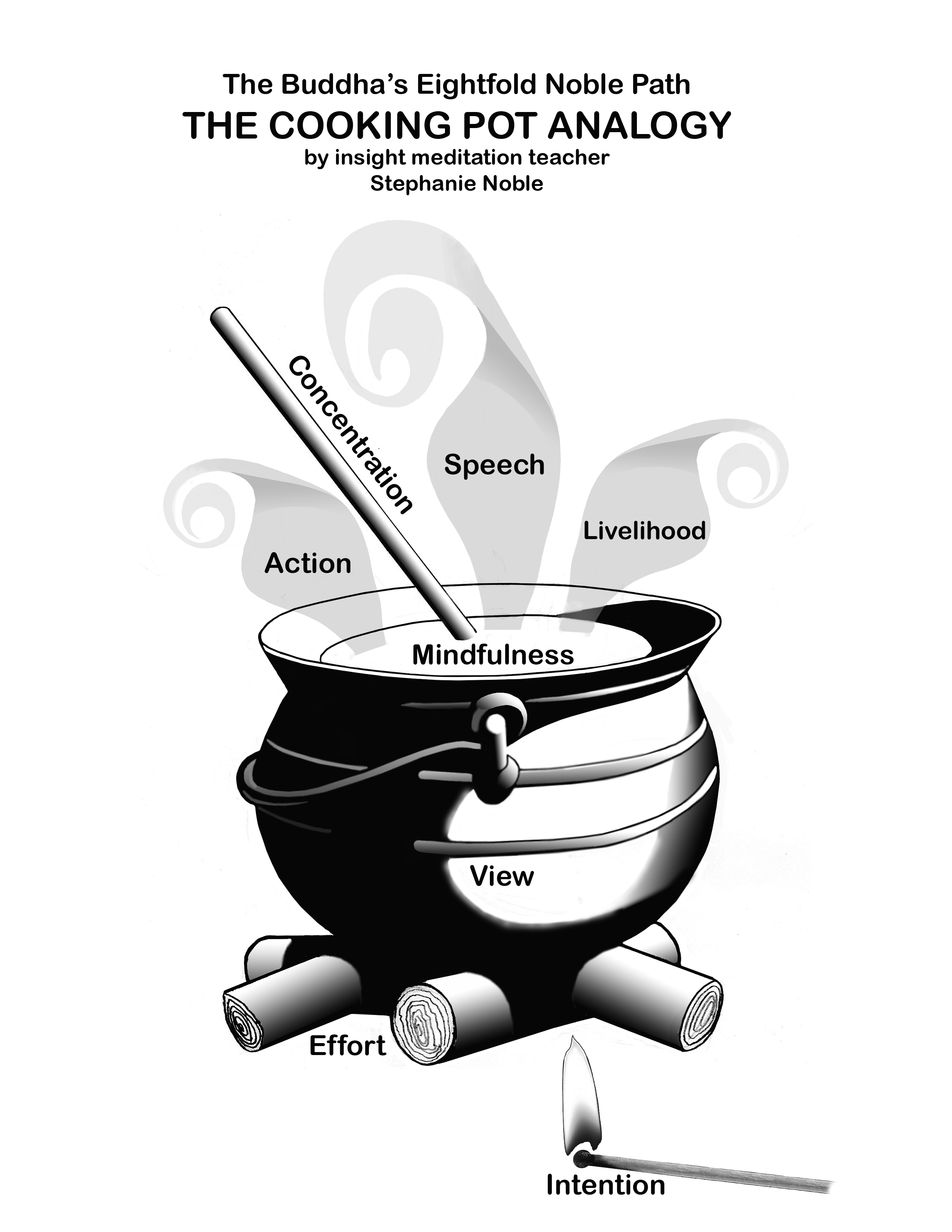
As you can see from my Cooking Pot Analogy, for our words and actions to be truly beneficial they arise naturally like steam with a delightful aroma from Wise View, Wise Intention, Wise Effort, Wise Mindfulness, and Wise Concentration.
If our words and actions aren’t wise, a kind of stench permeates the air. And we can trace those poorly chosen words and actions back to the other aspects that weren’t wisely cultivated. Or, unfortunately, we can let the stench undermine and sabotage our intentions and efforts. We may judge ourselves harshly and give up altogether.
Seeing dependent origination in the world, in our lives, is skillful. Simply noticing — without grasping, clinging, or turning away — how everything changes: the weather, the seasons, seeds becoming plants, providing oxygen, sustenance, and nesting places; and eventually inevitably becoming compost for new life. Everything is in cycles and rhythms of nature. And we are part of nature. Birth sets in motion aging and death. Really seeing and acknowledging without preferences helps us to live fully in each moment. It may feel easier to celebrate a baby or puppy, but can we celebrate all the becoming beyond that without regret? Can we appreciate our own body changing and take good care of it, not to cling to youth but to age with as much ease and grace and kindness as possible.
Grasping, clinging, and pushing away are culturally encouraged in a society focused on consumerism and growth at all costs. Recognizing the suffering in our cultural conditioning and inherited patterns down generations helps us to ease the harsh judgments we may be harboring toward ourselves, and that makes more room for lovingkindness, compassion, shared joy, and equanimity.
We see the processes of dependent origination most intimately in meditation and periods of quiet reflection. Then, as we develop the habit of noticing, we begin to notice it everywhere in our lives and in the world. This wholesome and helpful noticing deepens our understanding of the way of things. It reminds us of the power we have to bring joy or cause harm in radiating circles, like a drop of water in a still pond. We are powerful beyond measure! The gift of this meditation practice and the Buddha’s teachings is to learn how to use that power for the benefit of all life.


 STEPHANIE NOBLE