
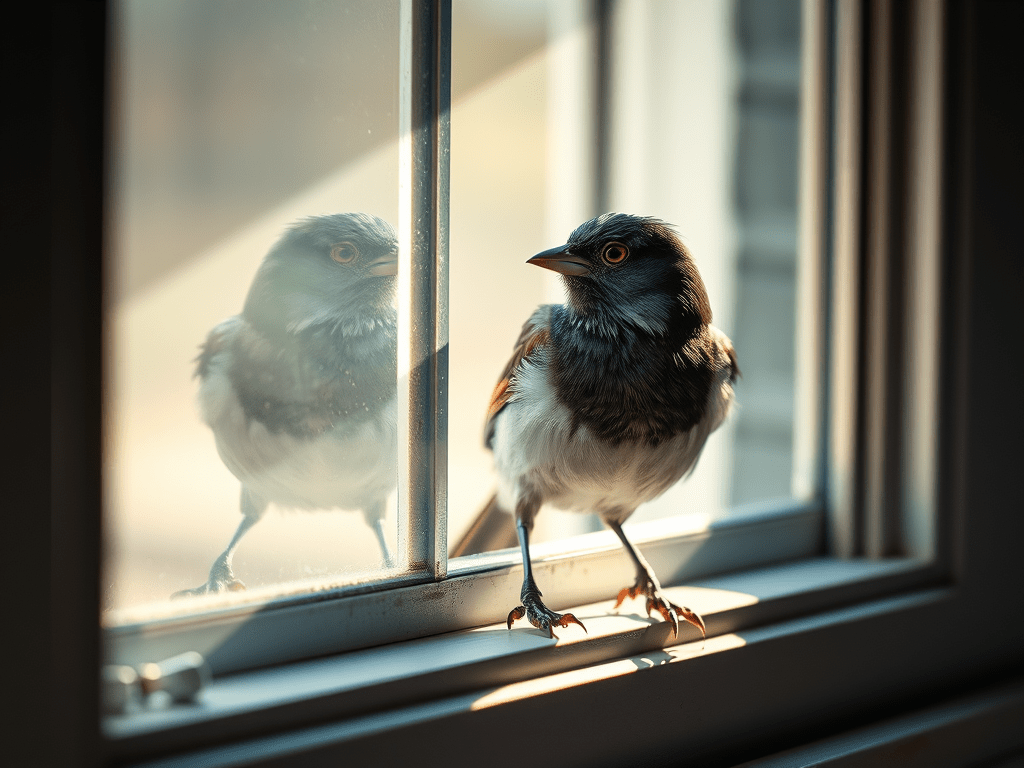
A dark-eyed junco keeps attacking the bedroom window, trying to defend his territory against his reflection. No matter what we do to dissuade him, he persists in this painful and futile activity, thinking he is bravely defending his mate and their nest nearby. No amount of curtains, screens, or dangling things dissuades him.
We have received advice from neighbors, bird lovers, and professionals alike. But after twelve days he’s still at it, seemingly none the worse for wear. I’ve named him Determined Herman. I have quiet conversations with him on the deck, but he keeps repeating the same phrase, which I interpret as, “You wouldn’t understand.”
Maybe not, but I am sympathetic. After all, don’t we do the same thing, banging our heads against reflections of our worst fears? We are drawn to images and ideas that justify that fear. We feel we have something to defend.
Sometimes we may have something to defend, just as Herman may sometimes need to defend against an aggressive bird of prey. But he is wearing himself out with his misguided attacks on his reflection. So he won’t be ready to do what he needs to do should the occasion arise.
Where in our lives might we doing the same? Most of us, to one degree or another, are attracted to windows on the world that have been carefully crafted to reflect our worst fears, deflecting us from spending our energy more wisely on co-creating a caring world community. And our engagement in these fearful reflections exhausts us so that we can’t see, for example, that an email is a scam, and we click on the link, or we rush to the ATM to deliver the cash to ‘the government’ or the people who are holding our ‘grandson’ hostage. The instructions demand we act fast, relying on our adrenaline-fueled fear to react without thinking it through.
For the perpetrators of these phishing schemes, it’s quite profitable to play on our fear. But why do we have that fear? Because we’ve been primed by the media who rely on advertisers. Fear sells!
Decades ago, my husband had a career in television news as a film editor. He saw how editorial choices focus on bad news and avoid good news that doesn’t keep viewers riveted. After twelve years, being surrounded by a growing editorial tendency toward fear-mongering took a toll on him. One day the news team was standing around his film editing desk debating whether to show the splatting of the body of a person who jumped to his death from a building to the sidewalk below.
Hearing in their voices the gleeful inhumanity of having ‘scored’ that dreadful film footage, he called me and said he couldn’t take it anymore. I encouraged him to quit if he wanted to. We’d figure it out. And we did.
I went back to work, he took care of the house and kids, and we were very frugal since my salary was a small portion of what he had been earning. We made a five-year plan for his career as an animator, combining his artistic skills with his film knowledge. He achieved that goal in two years, and has since made his living doing what he loves, creating joy through his art. An inspiration to us all! (Though, to be clear, he would have been content to remain a film editor if the newsroom wasn’t bent on purveying fear.)
We don’t need to work in television to know that the news leans into negativity. But we might consider that bad happenings have always been in the news because they are out of the ordinary and therefore ‘newsworthy’.
Many of us suffer from FOMO – fear of missing out. We are attached, even devoted, to our news sources. We don’t pause to consider our motivation before reaching for the cell phone, the tablet, the remote, or the newspaper. It’s a habit, perhaps almost an addiction. People may proudly say, “I’m a news junky.”
Of course, we need to be informed in order to make wise decisions, but can we curate our intake and care for ourselves? This would include researching our sources to be sure we are getting balanced reporting. But it also means asking ourselves whether we have to watch every horror in order to make informed decisions as citizens.
With the time we save doom-scrolling or glued to the screen, we can put our energy toward wholesome engagement. We can get to know our neighbors, collaborate, and co-create the world we want to see. You may have friends or relatives who exemplify this way of being in the world. I do, and they inspire me.
Can we respond from our love of life, rather than react from our fear?
Not all fear-based reflections are scary.
We also chase after what we desire, and never feel we have enough.
Maybe we:
- crave certain foods and keep finding ourselves at the refrigerator door
- have sexual or romantic fantasies
- long for a tropical vacation, a makeover, a sports car, a fancier house, or a getaway cabin.
Our imaginations are boundless and, again, businesses are booming as they promise to feed those fantasies and entice us to buy, buy, buy!
So what is skillful?
How do we turn away from these unwholesome projections and reflections that just leave us exhausted and unhappy?
First, we pause. We discover the value of taking care of ourselves, which is very different from indulgence. That care includes the regular practice of meditation, even just ten minutes a day. And coming home to the moment fully when we’re waiting in line, on the phone, at the airport, etc. We can convert ‘waiting’ into cultivating awareness.
With this subtle shift, we begin to see how our longings and unskillful actions are rooted in Greed, Aversion, and Delusion. We didn’t invent these Three Poisons, as they are called in Buddhism, and we’re not uniquely subject to them. They are not ‘character flaws’ and do not define us. But they do confine us. So when we recognize them, it’s cause for celebration, not chastisement. Like the Buddha, we can simply say “I see you.” If we said or did anything under their influence, we can apologize, make amends, and resolve to do better.
Only by recognizing the presence of a Poison can we release ourselves from the trance that causes suffering.
Snapping out of the trance, we discover a way of being that is life supporting. We can discover the rich offering we each have to give, letting go of comparing mind. Just as every kind of plant in the garden has a unique beauty, so do we.
Pause for a moment and think of some joyful expression of your being that you disregard, disrespect, and disallow in your life. Why? Because that reflected projection of who we believe ourselves to be and how we see the world keeps us hypnotized, afraid to look away, afraid to engage in real life that offers itself up in every moment, beyond the distorted reflection.
Right now, in March 2025, I keep hearing friends saying “I just feel like I need to do something!” There’s a restless desperate quality to this feeling. But if our intention is rooted in fear, our effort will likely be unskillful and exhausting. Our words and actions may only fuel divisiveness and more fear in the hearts of those who already fear our way of looking at things.
Fortunately, through the practice of moment-to-moment awareness, the confusing reflections fade, and we can begin to simply breathe, to simply live, to simply be.
In this way, when we have a challenge, whether in our personal lives or as citizens, we might resolve to spend maybe half an hour each day focusing on learning and doing positive things to help, rather than letting anxious worry cloud our minds and be the topic of every conversation all day long. A half an hour of dedicated action is worth more than 24/7/365 of worry. Imagine if we all took action that way instead of talking about it constantly!
Just like poor little Determined Herman, who is still battering his head against the window as I write this, we may project our view of a scary world and act aggressively, making the world less safe for ourselves and others.
But, though we may act like it at times, we don’t have bird brains! We have the capacity to pause and investigate, calm and clarify. We can recognize the presence of greed, fear, and delusion. And we can find skillful ways to respond instead of being stuck in the trance of fearful reactivity.
So, consider this an invitation to pause, take a breath, meditate, walk in nature, journal, dance, and come up with a plan for contributing to life-loving solutions rather than wasting precious energy battering away at fear-based reflections in the window of your mind. Open to Metta, infinite lovingkindness. Let it enter your field of awareness. Receive it fully. Then, when you’re ready, share it widely, sending it out into the world.
And as you do, kindly send some Metta to poor Herman, too.

 STEPHANIE NOBLE